


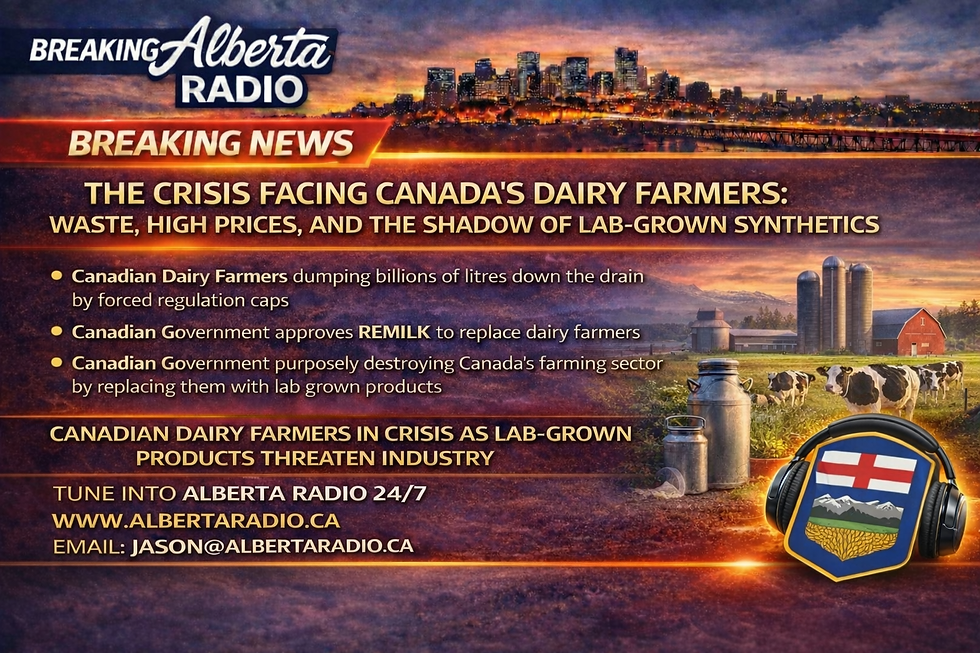
The Crisis Facing Canada's Dairy Farmers: Waste, High Prices, and the Shadow of Lab-Grown Synthetics
February 9th, 2026
by: Jason LaFace
Canada's dairy industry, long a cornerstone of the nation's agricultural heritage, is under siege. From Ontario farms forced to dump millions of litres of milk due to rigid production quotas, to skyrocketing consumer prices that strain household budgets, the sector is grappling with systemic issues rooted in federal regulations. Adding fuel to the fire is the recent approval of lab-grown dairy alternatives, like those from Israeli company Remilk, which critics argue could spell the end for traditional farming. This article explores these challenges, drawing on recent reports and expert analyses, while examining the broader implications for Canadian farmers and consumers. At its core, the debate pits regulatory stability against innovation, tradition against corporate-driven change, and provincial autonomy against federal oversight.
The Scandal of Wasted Milk: Billions of Litres Down the Drain
One of the most glaring failures of Canada's dairy supply management system is the chronic waste of perfectly good milk. Under this federally backed framework, production quotas—designed to match supply with domestic demand—often force farmers to discard excess output rather than sell or donate it. In Ontario alone, Dairy Farmers of Ontario reported dumping approximately 10.2 million litres of milk in November 2025, representing about 4.9% of the province's supply. This equated to roughly $18 million in lost retail value, with the butterfat component alone worth $10 million.
This waste occurred amid surging demand at food banks and persistently high grocery prices, highlighting a disconnect between policy and real-world needs.
The problem isn't isolated. In the 2020-2021 financial year, over 74 million litres were dumped in Ontario, with one farmer reportedly discarding 30,000 litres in a single month for exceeding his quota.
Nationally, studies estimate billions of liters discarded over the past decade, contributing to unnecessary environmental harm through increased greenhouse gas emissions and resource inefficiency. The COVID-19 pandemic exacerbated this, as sudden drops in food service demand left processors overwhelmed, leading to widespread dumping despite retail shortages.
Critics argue this waste stems directly from supply management's inflexibility, which prioritizes price stability over adaptability.
High Dairy Prices: A Burden on Canadian Families
Canada's dairy prices are among the highest in the world, largely due to the same supply management system that enforces quotas and import tariffs. This policy, in place since the 1970s, controls production, pricing, and imports to ensure farmers receive stable incomes without subsidies. While proponents praise it for preventing overproduction and market volatility—benefits seen in countries without similar systems, where prices can plummet and bankrupt farmers—the downsides are evident.
For consumers, this means paying a premium. The Canadian Dairy Commission announced a 2.3255% increase in farmgate milk prices effective February 1, 2026, aligned with inflation and rising costs like feed and labor.
Combined with storage charges, this translates to over 2 cents per litre more for processors, inevitably passed on to shoppers. In Ontario, this follows a trend of food inflation at 6.2% in December 2025, the highest among G7 nations.
Families already spend $300–$445 extra annually on groceries due to these protections, hitting low-income households hardest.
Defenders, including the Dairy Farmers of Canada, counter that the system sustains 270,000 jobs and contributes $28 billion to GDP, while ensuring high-quality, hormone-free products.
https://dairyfarmersofcanada.ca/en/canadian-goodness/articles/what-supply-management-means-canadians
It also avoids the bailouts seen in "free-market" systems like the U.S., where dairy farms face higher bankruptcy rates.
Yet, detractors point to low innovation, regional underservice, and vulnerability to shocks like pandemics or dairy alternatives.
Lab-Grown Dairy Enters the Fray: Remilk's Green Light
Enter Remilk, an Israeli food-tech firm that's shaking up the industry with its animal-free milk protein. Using precision fermentation—microbes engineered to produce proteins identical to those in cow's milk—Remilk creates dairy without cows, cholesterol, lactose, hormones, or antibiotics.
In early 2024, Health Canada issued a "Letter of No Objection," making Canada the fourth country (after the U.S., Singapore, and Israel) to approve Remilk's beta-lactoglobulin (BLG) protein for use in products like milk, yogurt, and ice cream.
The company touts sustainability: reduced water, land, and emissions compared to traditional farming. Supporters see it as a milestone for Canada's food-tech sector, offering allergen-labeled alternatives that could appeal to health-conscious consumers. However, opinions are divided. Some view it as a "new-dairy revolution," but farmers and skeptics worry it threatens livelihoods, with one social media post warning it could "wipe out real dairy farms." Health concerns linger over long-term effects, though Health Canada deemed it safe. Critics like Sylvain Charlebois argue it challenges tradition, potentially sidelining Agriculture and Agri-Food Canada's support for conventional dairy.
Underlying Fears: Climate Alarmism, Corporate Power, and the Erosion of Traditional Farming
Many Canadians, especially in provinces like Alberta, see these developments as part of a larger agenda. Regulations, they argue, are tightened under the guise of climate goals—reducing emissions from livestock—to favor lab-grown options. Remilk's lower environmental footprint aligns with this, but at what cost? Traditional farming could be phased out, replaced by "Petrie dish" products controlled by multinational corporations.
There's growing concern that corporations are influencing government policy, prioritizing profits over health. Long-term risks of lab-grown foods remain unknown, yet approvals proceed. If quotas were lifted, production could increase, prices drop, and waste end—benefiting all with affordable, natural dairy. But entrenched interests resist change.
The Root Problem and a Radical Solution: Federal Overreach and Provincial Exit
The federal government bears much blame, critics say, for favoring international agendas over citizens. Supply management, while protective, creates inequities, with Alberta often feeling alienated by policies that hinder its resource economy.
Polls show Alberta separation support at around 58%, driven by perceptions of unfair treatment—giving more to confederation than it receives.
Arguments for secession include economic independence, control over resources, and escape from "harmful federal policies." Opponents warn of landlocked challenges, economic instability, Indigenous treaty violations, and constitutional hurdles—secession requires negotiation, not unilateral action.
Yet, for some, like Alberta separatists, it's the only way to reclaim sovereignty.
If provinces and territories left confederation, they could tailor policies to local needs, free from Ottawa's grip.
Canada's dairy woes reflect deeper fractures. Without reform—lifting caps, scrutinizing lab-grown approvals, and addressing federal biases—the industry risks collapse. Canadians deserve affordable, healthy food from thriving farms, not corporate experiments. It's time to rethink the federation for a fairer future.


Comments